
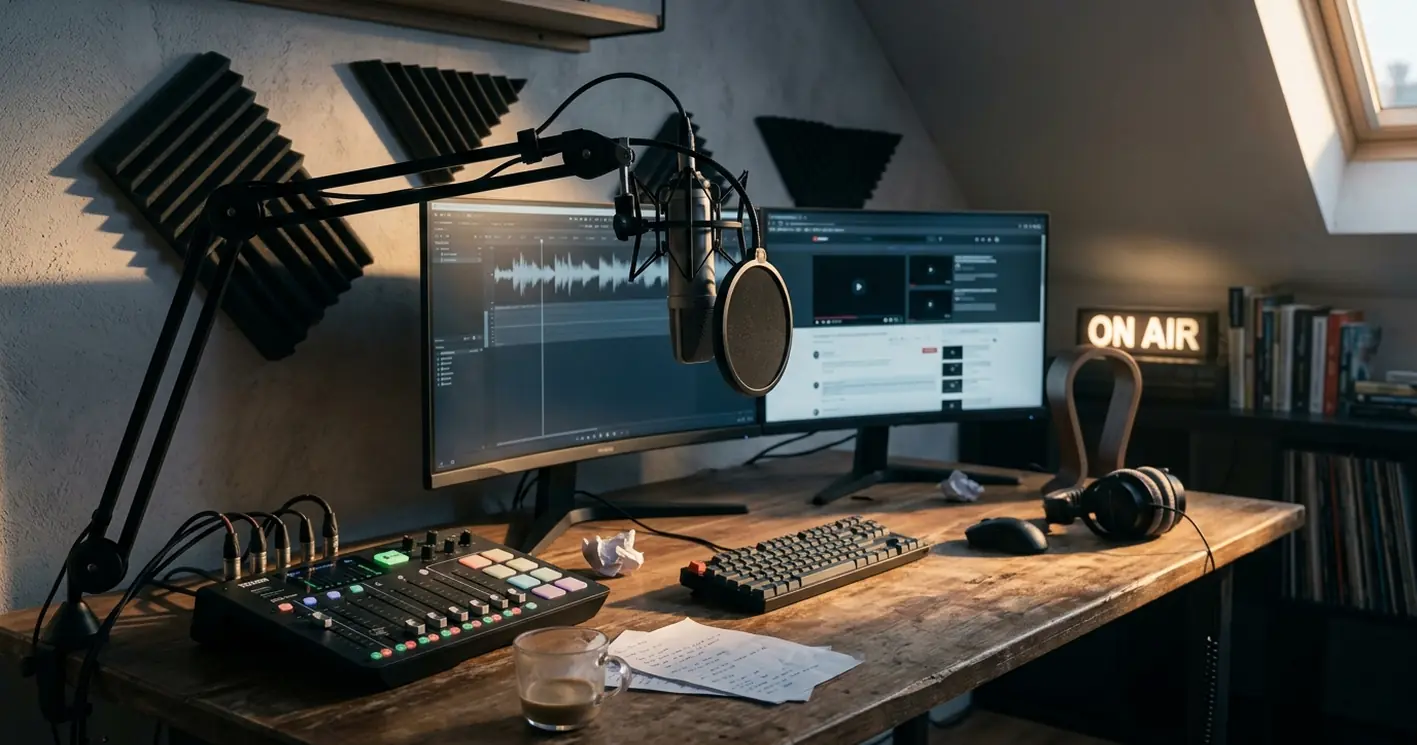
The Evolution of Audio-Driven Transmedia
Serialized audio never stayed still
Audio drama has always carried a hidden interface. In early serialized formats, that interface was the listener’s calendar: return next week, remember the unresolved scene, talk about it with someone before the next installment arrives. Podcasting changed the delivery mechanism, but it did not change the basic tension. RSS made distribution elegant and durable. It also made the listening experience stubbornly linear.
That constraint matters for transmedia storytelling because the feed is not a stage; it is a pipe. It carries an enclosure, a title, a description, and enough metadata for a client to display the episode. It does not naturally host an interactive design system, a branching story state, or a browser-native puzzle that reacts to listener choices.
Parallel Lives began as a response to that gap, not as a decorative web companion. The production team initially considered a standalone mobile application that would house both audio and interactive elements. That idea looked clean on a whiteboard. In practice, it asked listeners to install a new app before the story had earned the interruption, and the acquisition friction was too high for a serialized fiction project trying to move people quickly from curiosity to participation.
So the architectural question became narrower and more useful: how do you bridge an RSS-based audio feed with a browser-based interactive environment without making the listener feel punished for following the story?
The RSS-to-browser seam
Development of the core RSS-to-browser architecture ran across roughly five months, from late 2021 into early 2022. The important decision was not simply “send people to a website.” The engineers used custom RSS enclosure tags that appended dynamic URL parameters to episode show notes, passing listener metadata directly to the web server.
That sounds small until you have watched a podcast handoff collapse in the field. A listener hears a cue, opens the show notes, taps a link, and expects the browser to understand where they came from. If the web portal loads as a generic landing page, the spell breaks. If it opens at the right story node, with the right episode context, the browser feels like the next room in the same building.
Warning: Failing to embed direct, clickable hyperlinks in the podcast episode show notes, and relying on users to manually type URLs, resulted in near-zero platform migration. The bridge has to be tappable at the exact moment the story asks for motion.
Analyzing the Narrative Bridge in Parallel Lives
Consistency came before cleverness
Parallel Lives treated narrative continuity as a production system. That is the right instinct. When audio and web scenes both carry plot weight, the web episode cannot behave like bonus material. It has to resolve something the audio deliberately withholds.
The narrative bridging protocols were drafted and finalized over about six weeks in the autumn of 2022. Writers mapped the arc through a branching node system, then made one unusually disciplined choice: web-resolution triggers appeared exclusively at the end of act two. The placement gave listeners enough time to invest in the episode before the story asked them to change platforms.
Audio segments were capped at roughly 18 to 22 minutes before the mandatory web handoff cue. That cap did two jobs. It protected the pace of the episode, and it gave production a predictable window for writing cliffhangers that felt intentional rather than bolted on.
The cliffhanger had to require the browser
There are two ways to use a cliffhanger in digital media. One is promotional: stop the episode, tease a page, and hope people care. The stronger approach is structural: withhold a piece of narrative information that cannot be delivered properly in audio alone.
Parallel Lives leaned toward the second model. The audio could create ambiguity, tension, and emotional stakes. The browser could ask the listener to inspect an artifact, choose a path, or uncover a contradiction visually. The handoff worked when the web interaction answered a question the podcast had made urgent.
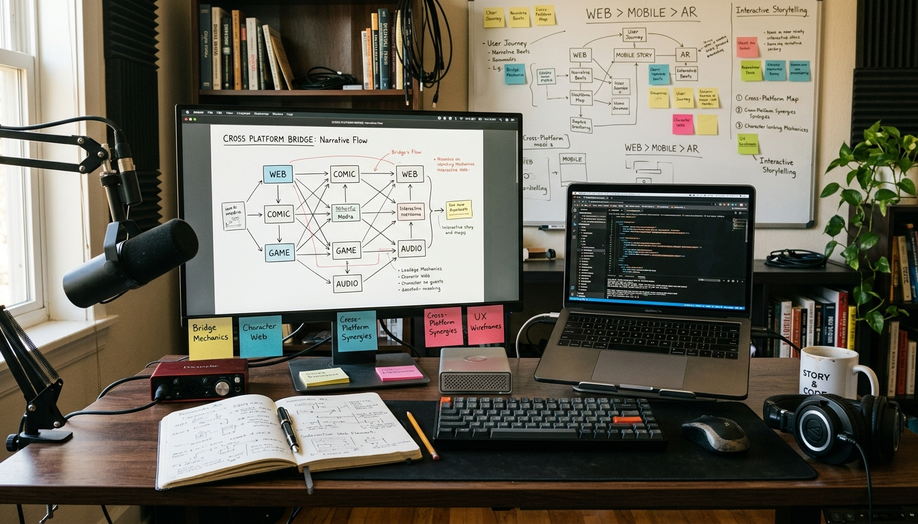
This is where the project’s method becomes transferable. The node map did not merely track plot branches; it tracked medium responsibility. Audio carried voice, atmosphere, and momentum. The web carried scrutiny, selection, and spatial context.
Key Takeaway: A transmedia bridge works best when each platform owns a different narrative verb. If both platforms only “tell,” the second platform becomes friction.
There is a limit worth naming. These branching frameworks fit serialized fiction because scenes can be drafted, revised, and recorded around the trigger points. Applying the same structures to unscripted or documentary formats introduces severe production bottlenecks, since real-world audio cannot be easily re-recorded to fit dynamic web triggers.
The effectiveness of audio cliffhangers also depends on the podcast client. Apps that auto-play the next episode can override the listener’s intent to pause and visit the interactive web portal. Narrative design can invite the handoff; the playback environment can still interfere.
Cross-Platform UX: Moving Listeners to the Browser
The hardest screen is the one between apps
I read the Parallel Lives UX as a study in interruption management. The listener is not sitting at a desk with patience and a second monitor. More often, the listener is on a phone, inside a podcast app, with one thumb and a narrow tolerance for ambiguity.
The browser handoff therefore had to answer three questions immediately: Am I in the right place? Did the story remember me? What do I do next?
Implementation of the mobile-first responsive CSS grid took place over about three weeks in January 2023. The interactive portal prioritized initial text and CSS assets so the first meaningful view could load in roughly a second during the app-to-browser switch. That threshold mattered less as a vanity performance number than as a storytelling safeguard. Delay feels like doubt.
Visual continuity reduced cognitive load
The design team synchronized the web interface’s color palette with the podcast’s cover art metadata, extracting dominant hex codes dynamically so the opened browser view echoed the audio brand the listener had just left. This was not cosmetic polish. It was orientation.
In a weaker implementation, the web portal would introduce a new visual language and ask the listener to re-learn the project mid-scene. Parallel Lives kept the transition familiar: colors, motifs, and episode context all confirmed that the user had crossed platforms without leaving the story world.
The technical pattern was plain but disciplined:
- Keep the first browser view narrow in purpose.
- Load story context before decorative assets.
- Use the episode parameter to place the listener at the correct node.
- Mirror podcast art direction so the browser feels continuous with the feed.
- Make the next action visible without requiring explanation.
For teams using richer audio manipulation in the browser, the Web Audio API specification is the right technical reference point. But Parallel Lives did not treat browser audio as the main attraction. The stronger UX move was restraint: let the podcast remain the primary listening surface, then let the web do what the feed cannot.
Pro Tip: Design the first web screen as a continuation cue, not a homepage. The listener is arriving from a specific dramatic moment, not browsing your project archive.
Practical Tactics for Production and Tracking
The story bible needs database discipline
A transmedia story bible cannot live as a loose document once multiple teams start shipping against it. Parallel Lives maintained its centralized story bible through a relational database schema updated weekly across the spring of 2023. That choice gave writers, designers, engineers, and producers a shared source for episode state, character knowledge, web nodes, and handoff cues.
The useful lesson is not “use a database” in the abstract. The lesson is to model the story elements that create production risk. If a web artifact reveals information before the audio has earned it, the system should expose that conflict early. If a character’s knowledge changes after a browser interaction, the next script draft should reflect it.
A practical schema can start with a few core tables:
- Episodes, with act structure and audio handoff timing.
- Story nodes, with required entry conditions and resolution states.
- Characters, with knowledge flags tied to episode and web events.
- Assets, with ownership, publication status, and platform destination.
- Redirects, with source episode, target node, and campaign parameters.
This kind of structure sounds procedural because it is. Creative teams often resist it until the first continuity mistake reaches users. Better to make the machine visible before launch.
Tracking should measure motion, not pretend to identify everyone
The analytics setup followed the same pragmatic line. The team configured custom UTM parameters inside podcast show notes, then routed traffic through a centralized redirect script to capture initial click data before passing users to the interactive portal.
Cross-platform engagement metrics relied on server-side log analysis to capture redirect requests. Because privacy updates and cookie deprecation weaken one-to-one tracking, the team treated the data as aggregate behavioral trends rather than exact user counts. That distinction protects the analysis from false precision.
For production decisions, trend-level evidence can still be useful. If a handoff from one episode consistently sends more traffic than another, the team can inspect the cue, the show-note placement, the platform behavior, and the web load path. The question is not “which named listener moved?” The question is “which story moment created enough intent to cross the seam?”
A workable tracking plan should include:
- Episode-specific UTM parameters embedded in direct show-note links.
- A redirect endpoint that logs the request before forwarding the user.
- Server-side aggregation by episode, platform family, and target story node.
- Dashboard annotations for release dates, feed changes, and web deployments.
- Editorial review sessions where analytics sit beside script and UX notes.
The last step is easy to skip. It is also where the work becomes useful. Numbers without the episode draft, the handoff copy, and the interface state tend to produce guesses dressed as insight.
The Future of Hybrid Storytelling
The overhead is part of the format
The Parallel Lives post-mortem ran over about two weeks in June 2023. The finding that stayed with me is operational rather than theatrical: future projects would require a dedicated technical director from day one to manage the overhead of synchronizing audio feeds with web delivery.
That is the clearest implementation takeaway. Hybrid storytelling is not just writing plus web development. It is release management, metadata discipline, responsive interaction design, analytics interpretation, and editorial continuity under one production rhythm.
Final deployment required two separate hosting environments: a standard CDN for the MP3 files and a Node.js server for the interactive web components. That split is sensible, but it creates coordination work every time an episode, node, redirect, or asset changes. The architecture lets each medium do its job. It also removes the comfort of a single publishing surface.
What Parallel Lives makes harder to ignore
For creators in the startup ecosystem, the temptation is to pitch transmedia expansion as a growth layer. Parallel Lives suggests a tougher standard. The expansion has to solve a narrative problem that the original medium cannot solve cleanly on its own.
If the browser only hosts extras, the podcast remains the real product and the web becomes a chore. If the browser resolves tension, reveals context, or asks the audience to participate in a way audio cannot support, the overhead starts to make sense.
The future of hybrid storytelling will not belong to the most elaborate stack. It will belong to teams that can assign the right job to the right medium, then maintain the connective tissue with enough care that users never feel the machinery scraping against the story.
What unresolved moment in your current narrative is strong enough to justify asking a listener to leave the podcast app and cross into the browser?











Responses
Be the first to comment.
Write a Comment