

The Urban Canvas and the Attention Deficit
Three channels, one city-scale prompt
The Echo Chamber ARG simultaneously operated across three distinct mediums: a dedicated mobile app, live social media feeds, and hidden physical installations distributed through Manhattan, Brooklyn, Queens, and the Bronx. Active deployment and live monitoring ran from September 14 to October 28, 2023, which matters because the project did not treat New York City as a backdrop. It treated the city as interface.
That choice set the baseline challenge. In a high-density urban environment, attention gets shredded by transit alerts, street noise, unread messages, crowded sidewalks, and the small survival math of getting from one place to another. A purely web-based launch would have been cleaner to manage, and the design team initially considered that route. They discarded it in favor of the tri-medium structure because Echo Chamber needed immediate physical engagement, not later curiosity.
The case turns on friction. Not theatrical scale. Not the novelty of NFC tags. Not the pleasure of calling something an alternate reality game. The useful lesson is narrower: urban transmedia storytelling works when the path from digital discovery to physical action feels shorter than the player expects.
I read Echo Chamber as a disciplined handoff machine. Social media created ambient suspicion. The app converted suspicion into direction. The physical installations made the suspicion tactile. Each medium had a job, and the campaign resisted the common temptation to make every platform carry the same piece of story in a different wrapper.
Key Takeaway: In a dense city, the strongest design move is not adding another channel. It is removing the pause between noticing a clue and doing something with it.
Diagnosing Transmedia Drop-Off
Where the player leaves the fiction
From August 3 to August 17, 2023, the team ran a closed beta focused on user-flow mapping. The useful detail is not that players dropped away during complex puzzles. They dropped at the seam between one mode of behavior and another: scrolling a social feed, then opening maps, then deciding whether a physical trip still felt worth it.
ARGs that rely on players manually inputting physical coordinates into third-party mapping applications often see immediate user abandonment due to context-switching fatigue. That sentence sounds technical, but the experience is ordinary. A player sees a clue while standing on a train platform. The clue asks for coordinates. The player copies them, opens another app, waits for a route, loses the post, and now the fiction has become an errand.
Echo Chamber attacked that seam directly. Social feed clues contained embedded GPS coordinates that automatically populated the mobile app's internal compass, bypassing third-party map routing. The player did not need to become a logistics manager. The app absorbed the translation layer.
Warning: A platform switch is not just a technical transition. It is a change in posture, attention, and tolerance. If the story cannot survive that change, the player will not carry it for you.
The harder challenge was tonal. Echo Chamber had to feel native to a fast-scrolling social feed and to slow physical exploration. Those are almost opposite reading conditions. A feed rewards compression, hooks, partial statements, and reactive comments. A street installation rewards patience, peripheral vision, and the small thrill of noticing what others pass by.
So the design question becomes practical: what belongs in the feed, and what belongs on the street? Feed clues carried urgency and social proof. Physical nodes carried commitment. The app sat between them, turning speed into direction without flattening the mystery.
Analyzing Echo Chamber's Narrative Architecture
The matrix behind the mystery
Echo Chamber's architecture worked because the creators mapped contribution, not duplication. A weaker cross-platform build gives each channel a recap and hopes repetition creates clarity. This one divided narrative reveals into 14 distinct threads, then required players to scan NFC tags on fabricated street signs to unlock the corresponding digital lore.
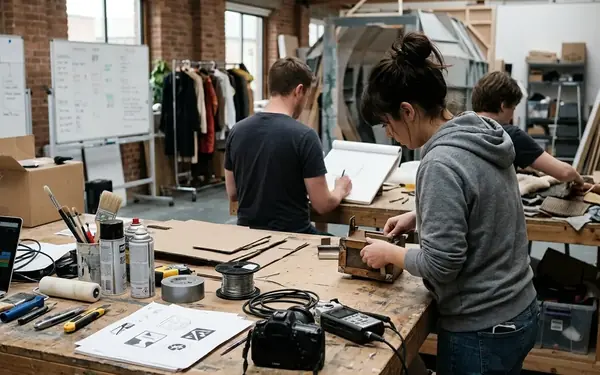
Prop fabrication and narrative mapping took place between May 10 and July 22, 2023. That long pre-launch phase shows up in the finished experience. The social layer could sound ragged and conspiratorial because the physical layer had already been assigned a different burden: proof, texture, and place.
Transmedia theory often starts with the idea that each medium should do what it does best; MIT's Comparative Media Studies/Writing program has long described the foundational principles of transmedia storytelling in terms of coordinated expansion rather than simple adaptation. Echo Chamber gives that principle a street-level implementation. A post was not a poster in miniature. A poster was not a frozen social update. The app was not a website with GPS.
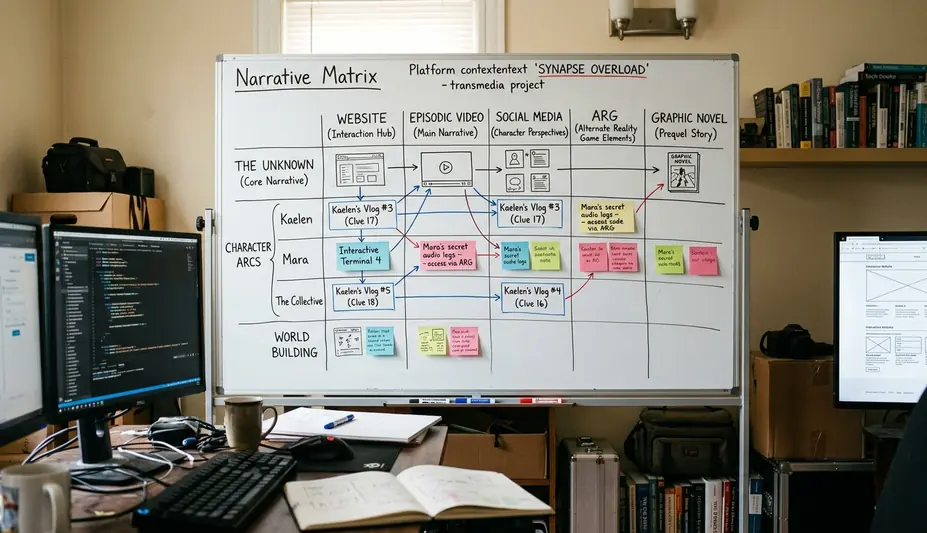
The editorial matrix held the tone together. User-generated social content needed the same gritty, conspiratorial pressure as the professionally fabricated physical props, but it could not sound prewritten. That is a narrow lane. Too polished, and the fiction collapses into campaign copy. Too loose, and the world stops feeling authored.
The matrix solved this by assigning constraints rather than scripting every utterance. A social clue could speculate, misdirect, or amplify. A fabricated sign could confirm, encode, or unlock. App lore could deepen backstory after the player had earned it in the street. The division kept each channel legible.
There is a real scope limit here. This synchronized architecture relies on dense urban centers with strong public transit infrastructure; deploying a similar model in suburban or rural environments would require different pacing, travel-time allowances, and probably a looser model of simultaneous discovery.
Cross-Platform Implementation Mechanics
The app as connective tissue
The mobile app did the least glamorous work in the system, which is why it mattered. It joined social clues to physical sites, cached physical location data, and triggered digital rewards immediately after real-world interaction, including in areas with poor cellular reception.
That immediacy protected the fiction. When a player reached a node, scanned it, and received new content without waiting through a dead connection, the city still felt responsive. Delay would have made the installation feel like a broken object. Instant response made it feel planted there for a reason.
The physical layer used weather-resistant, low-profile NFC stickers disguised as municipal inspection tags. They were placed at eye level on public utility boxes. Installation of the 42 physical nodes occurred during overnight shifts from September 8 to September 12, 2023, which suggests a design process tuned to visibility, interference, and the rhythms of public space.
Implementation sequence
Broadcast the clue: A live social feed post introduced a fragment of lore with embedded location data.
Transfer the intent: The embedded coordinates opened the app's internal compass instead of sending the player into a third-party mapping flow.
Locate the node: The player searched the block for an object that blended into ordinary urban infrastructure.
Scan the tag: The NFC interaction confirmed presence at the site and unlocked the next piece of digital lore.
Reward the effort: New content appeared immediately, making the physical trip feel narratively consequential.
The durability of physical props must be scaled to local weather patterns and municipal cleaning schedules; installations in high-traffic transit hubs require different adhesives and camouflage than those in residential alleys. Echo Chamber's choice of inspection-tag disguise worked because utility boxes already carry small, semi-official markings. The design hid in a visual language the city had trained people to ignore.
Pro Tip: In physical-digital design, camouflage should not mean invisibility. It should mean plausible presence until the player has the right reason to look closer.
This is where interactive design stops being abstract. The app, the NFC sticker, the social clue, and the utility box formed one interaction chain. Break any link and the player feels the machinery. Keep the chain tight and the city becomes part of the interface.
Audience Retention and Narrative Coherence
Why coherence outperformed spectacle
Coherence did more retention work than novelty. Echo Chamber had enough tech innovations to attract attention, but the campaign's qualitative success came from the way each channel protected the meaning of the others.

Retention monitoring and community analysis were actively logged from September 15 to November 5, 2023. The team evaluated campaign success by looking at completion of location-based puzzle chains and by watching how players used the app's localized chat channels. Those channels became coordination spaces, with users arranging physical meetups to activate multi-node puzzles together.
That behavior is important because community formation was not bolted on as a generic social feature. It emerged from the structure of the puzzles. Some nodes asked for simultaneous presence. Some lore only made sense once players compared what they had unlocked in different boroughs. The design gave people a reason to meet before it gave them a place to talk.
There are two ways to interpret that outcome. The shallow interpretation says players liked the location gimmick. The stronger reading is that the narrative made individual progress feel incomplete in a productive way. A player could move alone, but the story kept implying that someone else had seen another angle.
For digital media teams, that is the exportable lesson. A campaign does not retain people because it uses a mobile app, social feeds, NFC, or urban props. It retains them when the audience can feel why each element exists. If the app only confirms what the feed already said, it becomes administrative. If the physical node only decorates the digital clue, it becomes scavenger-hunt dressing. Echo Chamber avoided that by giving every handoff a new narrative function.
Social feeds created public momentum and rumor density.
The mobile app handled direction, confirmation, and immediate reward.
Physical installations converted attention into embodied commitment.
Localized chat turned fragmented discoveries into shared interpretation.
That structure also explains why the experience could support creator spotlights without feeling like a marketing layer. The system gave players something specific to do with each contribution. In a startup ecosystem obsessed with new channels, Echo Chamber is a useful corrective: the channel is only interesting when it changes the player's next action.
The Final Connection
When the city answered back
The final sequence was accessible from October 21 to October 28, 2023, and it required a specific environmental context. The design team choreographed the climax so the mobile app unlocked only when device sensors confirmed the player was in the designated setting. The last step was not simply reaching a coordinate. It was being in the right physical condition for the story to close.
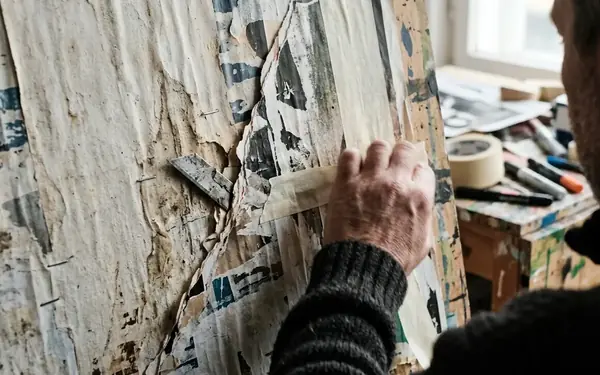
The object itself was modest: a weathered poster in a dimly lit Brooklyn subway station, carrying a micro-patterned QR code. It did not announce itself as a finale. It looked tired, pasted over older paper, softened by platform dust and fluorescent light.
A player stands near the tiled wall while the train wind moves through the station. Their phone camera catches the pattern. The scan lands. For a second, the poster, the app, the station noise, and the weeks of scattered clues line up as one system. The final audio-visual sequence opens in their hand, and the city does not feel like scenery anymore. It feels like it has been speaking the whole time.












Responses
Be the first to comment.
Write a Comment