

A Tuesday Reveal Breaks Friday’s Interactive Launch
At 9:14 AM on a Tuesday, a social scheduler releases a character-reveal clip from a midtown Manhattan production studio. In this campaign scenario, the clip belongs behind Friday’s interactive web hub launch. Instead, the audience receives the answer roughly 75 hours before the experience that makes the answer meaningful.
The clip plays correctly. The publishing system has still failed.
The social desk follows its own platform calendar, while the web team follows a deployment schedule. Each calendar looks reasonable in isolation. Neither expresses the dependency that matters: the audience must encounter the unresolved story before receiving its resolution.
This is the structural risk in transmedia storytelling. Independent broadcast schedules flatten a connected narrative into interchangeable posts. A character’s identity, an invitation to investigate, and a retrospective explanation can occupy identical slots in a scheduler despite serving incompatible purposes.
A three-week flight concentrates attention around a bounded sequence. That compression also leaves little room to rebuild downstream material after an early disclosure. Recutting the reveal alone cannot restore an information gap the audience has already crossed.
Protect The Reveal
Every reveal-bearing asset needs a release dependency tied to the live anchor experience. A calendar date alone cannot establish readiness.
The framework below applies to narrative launches and lore-driven product drops. Always-on acquisition campaigns can prioritize different objectives; chronological plot integrity is the organizing constraint here.
Give Every Asset a Teaser, Payoff, or Recap Job
Narrative role should govern release eligibility. Format should govern production and delivery specifications.
A vertical video can introduce a mystery, disclose its answer, or explain its significance afterward. Grouping all three under the same technical specification makes substitution dangerously easy. An editor searching for a compatible clip needs to see its narrative function before its aspect ratio.
Teasers Open a Specific Information Gap
A Teaser presents an incomplete fragment and gives the audience somewhere useful to pursue it. For the character-reveal campaign, that fragment might be a contradictory message attributed to an unidentified speaker. Its call to action leads from an algorithmic feed into the owned hub, where the audience can investigate.
The fragment must remain intelligible on its own. Concealing everything produces confusion; withholding one consequential answer creates a reason to move.
The Payoff Resolves the Promised Question
The Payoff is the anchor experience: an interactive web canvas or core episode that resolves the tension established by the Teasers. Interactive design earns its place when exploration helps the audience understand the disclosure. Extra clicks without narrative consequence merely delay it.
Recaps Reconstruct the Route
A Recap gives late arrivals enough context to enter the continuing story. It can disclose earlier events because its purpose is orientation. That makes it unsuitable for the opening discovery phase.
Keep Recap eligibility within Days 11–21, then apply the specific flight’s spoiler hold. In the schedule below, the first Recap appears on Day 13.
Name The Dependency
Use a role-first filename such as W1_TEASER_04_9x16.mp4. Record its prerequisite, approved destination, spoiler status, and release owner in the master asset ledger.
The filename helps people recognize the asset. The ledger determines whether publishing it is safe.
Separate Hub Discovery From Public Spoiler Clips
Owned hubs and social feeds impose different reading orders. A visitor to the hub chooses where to explore and when to continue. A feed can place a decisive cutdown in front of someone who has never encountered the opening invitation.
The spoiler window addresses that mismatch. It begins when the Payoff becomes publicly usable on the owned platform and ends when official channels may publish material that explicitly dissects the reveal.
Start the clock from verified availability. A scheduled deployment time cannot protect the audience if the interactive canvas still fails to load.
- A 24-hour hold favors a compact discovery cycle around a midweek release. It protects an initial exploration period while allowing official interpretation to follow relatively quickly.
- A 72-hour hold gives a Friday afternoon release room to accommodate weekend browsing. It also requires spoiler-safe material to sustain the public conversation.
- The 48-hour hold used below separates Day 10 exploration from explicit social cutdowns. The first Recap follows on Day 13.
These durations are scheduling choices, not measured guarantees of audience completion. The appropriate comparison concerns which viewing opportunity the campaign intends to preserve.
During the hold, official channels can publish navigation help, technical support, and reactions that avoid identifying the character. Community screen captures remain outside the team’s publishing control. The protocol governs official amplification rather than promising secrecy across the internet.
Record both the embargo’s expiry timestamp and its content boundary. “No spoilers” leaves too much room for interpretation; “no character name, face, or explanation of the final interaction” gives editors a usable rule.
Sequence the 21-Day Flight Around the Day 10 Payoff
The campaign’s critical path runs through two gates: opening the hub on Day 5 and unlocking the anchor on Day 10. Before the first gate, Teasers route to an intentional email-capture lobby. After it, visitors can explore the opening material without accessing the protected reveal.
The following sequence is a working blueprint, with each day assigned a narrative job.
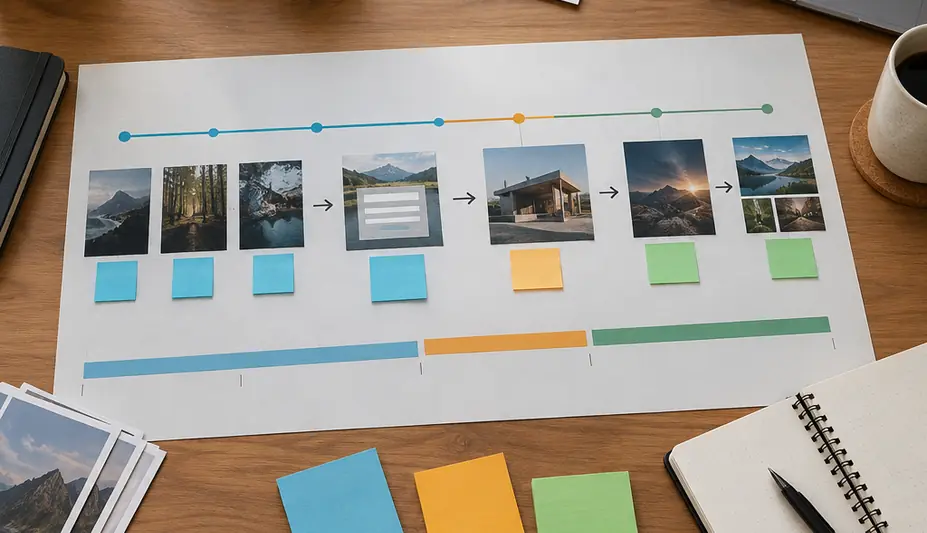
Days 1–7 Build the Unanswered Question
- Day 1: Publish the opening ambient Teaser and route its call to action to the holding lobby.
- Day 2: Extend the same mystery through a complementary fragment on a secondary channel.
- Day 3: Introduce a clue that rewards attention without identifying the concealed character.
- Day 4: Announce the approaching threshold and verify the hub-opening destination.
- Day 5: Release the threshold marker and open the primary interactive hub.
- Day 6: Direct visitors toward an available interaction that deepens the central question.
- Day 7: Reinforce the unresolved clue and establish the next return point.
Days 8–14 Deliver and Protect the Answer
- Day 8: Publish a Teaser connecting the opening fragments to the approaching anchor.
- Day 9: Confirm the release destination and queue only approved, spoiler-safe invitations.
- Day 10: Unlock the Payoff on the owned platform; begin the 48-hour embargo after verification.
- Day 11: Support exploration with navigation guidance while explicit reveal clips remain locked.
- Day 12: Release approved cutdowns only after the full embargo expires.
- Day 13: Publish the first Recap, giving mid-flight entrants a coherent route into the story.
- Day 14: Connect that Recap to the anchor and the remaining unresolved thread.
Days 15–21 Interpret the Story and Prepare Its Continuation
- Day 15: Shift scheduled output entirely toward Recaps and lore expansion.
- Day 16: Explain a secondary detail whose meaning changed after the character reveal.
- Day 17: Gather audience interpretations for possible inclusion in the wrap-up.
- Day 18: Review permissions and distinguish audience theories from established story facts.
- Day 19: Publish a canonical synthesis that incorporates selected audience reactions with clear attribution.
- Day 20: Introduce the unresolved consequence that will connect to the next release.
- Day 21: Publish the closing Recap and a precise invitation to the next drop.
Audience participation needs an editorial boundary. Reactions can become part of the official wrap-up without automatically turning every interpretation into fictional canon.
Make the Publish Check Capable of Stopping the Queue
A pre-flight review has value only when its findings can change the publishing state. Run the audit before Day 1, then repeat it before the Day 5 and Day 10 gates.
- Audit dependencies and timestamps. Compare the master ledger with every scheduler and CMS environment. Inspect ingest timestamps, publication times, timezone settings, and asset versions. Confirm that no Payoff derivative or Recap can publish before its prerequisite experience resolves.
- Verify routes and fallback states. Follow each public call to action through its actual destination. Check the lobby, opening hub, anchor route, and expired-link behavior. Early visitors should reach an intentional “signal incoming” state rather than a missing page.
- Assign pause authority and delay rules. Give a named launch owner control over the downstream queue. If the interactive deployment slips by six hours, hold every reveal-bearing cutdown, Recap, and post promising immediate anchor access. Route incoming traffic to the prepared holding screen.
Keep operational updates available during a pause. After recovery, verify the public experience, restart the spoiler clock from actual availability, and recalculate dependent releases before rearming them.
Gate The Cutdowns
The release ledger should make the consequence of a delayed anchor explicit: dependent posts remain paused until the hub works and the spoiler window has elapsed.
If the Day 10 canvas slips by six hours, which named owner can stop every dependent reveal before the next social post fires?












Responses
Be the first to comment.
Write a Comment