
Synchronizing Live Narrative State to Prevent Multi-City Scene Drift
Simultaneous physical and digital activations require state agreement across geographically separated points of presence within a 150-to-300-millisecond window in most situations to prevent audible spoilers over shared voice channels. Live narrative state payloads encapsulate a JSON tree of unlocked clue IDs, global countdown vectors, and branching boolean flags averaging about 14 to 28 kilobytes per broadcast. On a transmedia marketing platform, this payload acts as the canonical, real-time record of plot progression and audience triggers across every connected screen and installation.
Scene drift occurs when geographically separated audiences experience story beats out of sequence due to network latency. In interactive design, a half-second delay between two venues can break the illusion of a unified world. When a crowd in Chicago solves a physical cipher while connected via live audio to a partner crowd in Seattle, both groups must see the vault door unlock on their local displays at the same perceptual moment.
Testing across urban deployments can establish baseline synchronization criteria by logging every physical QR trigger alongside WebSocket frame arrivals. Where cross-city telemetry logs diverge beyond human perceptual thresholds for group reactions, the discrepancies can require a complete architectural redesign. Creators have increasingly demanded this sub-second parity to merge live theater with web development. However, these engineering observations apply specifically to high-concurrency, event-driven interactive narratives where thousands of participants mutate a shared state simultaneously, rather than static video streaming or pre-rendered content delivery.
Origin Round-Trip Latency and Timeline Fractures in Coast-to-Coast Campaigns
When diagnosing post-mortem logs from a coast-to-coast campaign, infrastructure leads traced timeline fractures directly to connection pool exhaustion at the central database. Every tap on a mobile interface and every badge scan at a physical kiosk required a full network round-trip back to a single regional origin server before the plot could advance. That centralized bottleneck turned a synchronized narrative into a fragmented race against geography.
Centralized relational architectures running in a single eastern cloud region forced western venue devices to endure 85-to-140-millisecond network round-trips before database query execution even began. During peak puzzle resolution windows lasting 45 to 90 seconds, connection pools capped at 500 concurrent transactions backed up. The resulting queue served stale narrative branches for up to 12 seconds while mobile participants in lower-latency zones had already unlocked the finale screen.
This cross-coast scene drift during the 45-to-90-second puzzle resolution window—where 500-connection origin pool saturation leaves physical venue screens locked 12 seconds behind mobile finale triggers—destroys the collective tension of transmedia storytelling. Audiences standing inside a western pop-up venue stared at a frozen countdown clock while reading spoilers in global chat channels from eastern participants who had already completed the event. Mapping every sequential read-lock contention point proved that scaling vertical database instances at a single origin could never overcome physical transit delays.
Relocating Narrative State to Distributed Edge Workers and Coordinator Nodes
Eliminating cross-country database round-trips required evaluating two distinct distributed state models: multi-region active-active relational clusters versus conflict-free replicated data types and edge storage primitives. Platform architects ruled out active-active SQL due to its complex split-brain recovery overhead during high-velocity puzzle bursts. Instead, the architecture shifted toward serverless edge workers bound to single-threaded, strongly consistent distributed storage objects, a pattern detailed in the Cloudflare Durable Objects documentation on strong consistency at the edge.
In this model, local edge nodes ingest participant inputs at the nearest point of presence and validate payload structure immediately. Rather than locking rows in a distant relational table, the edge worker forwards state-mutation proposals to a designated coordinator node. This coordinator resolves deterministic story progression via monotonic Lamport timestamps within 15 to 40 milliseconds under normal use, broadcasting the updated 14-to-28-kilobyte JSON state tree back out across the global mesh.
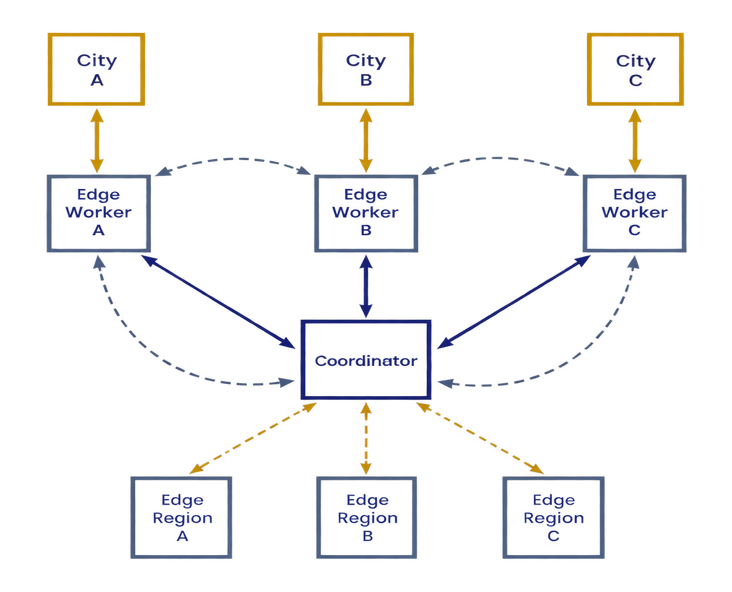
Deterministic ordering ensures that when thousands of participants submit puzzle solutions at the exact same millisecond, the coordinator serializes the requests without race conditions or deadlocks. Edge infrastructure does impose strict resource discipline on digital media teams. Pre-launch governance audits verify that compiled worker scripts remain under the 1-megabyte compressed bundle ceiling and stay below the 128-megabyte per-isolate memory limit during simulated 10-minute traffic spikes.
Isolate Memory Governance: Keep compiled edge worker bundles under 1 megabyte and runtime consumption below the 128-megabyte per-isolate ceiling to prevent cold-start evictions during peak story transitions.
Operational Playbook for Shipping Timed Multi-Location Story Drops
Shipping a synchronized multi-city activation requires trading traditional web deployment habits for broadcast-grade pre-flight discipline. Operations groups managing timed drops have shifted telemetry away from aggregate cloud CPU dashboards, configuring per-city synthetic probes that continuously validate state convergence prior to opening the physical doors.
- Pre-Warm Edge Isolates and Hydrate Local Caches: Runbook protocols mandate pre-warming edge isolates and hydrating local read-caches 15 to 25 minutes before countdown timers hit zero. Sending synthetic heartbeat traffic across every target city point of presence ensures that initial audience requests hit hot memory rather than triggering cold-start compilation penalties.
- Enforce Idempotent State Transition Keys: Frantic crowds tap screens repeatedly when a countdown reaches zero. Structure every story beat mutation around idempotent state transition keys hashed from the user session ID and the target scene identifier. When a participant submits duplicate triggers within a few hundred milliseconds, the local edge node recognizes the hash and returns the current scene state without advancing the global plot counter twice.
- Simulate Regional Network Partitions: Before launch day, inject artificial latency and packet loss between regional edge nodes and the coordinator instance. Verify that local venue displays degrade gracefully to ambient holding loops rather than rendering raw error codes if a municipal fiber cut isolates a city for several seconds.
Every architectural decision in live digital media remains strictly bounded by the 128-megabyte edge isolate memory ceiling and the 200-kilometers-per-millisecond refractive speed limit of fiber-optic glass across multi-city transmedia drops. Light traveling through fiber-optic glass propagates at roughly 200 kilometers per millisecond—about one-third slower than in a vacuum, meaning a single 8,000-kilometer transcontinental round-trip to a centralized origin server consumes 40 milliseconds in raw physical transit alone before a single line of story logic executes.












Responses
Be the first to comment.
Write a Comment