

Why Founder Narratives Slow Executive Profile Clearance
How can an editorial team structure an executive profile so corporate counsel signs off within forty-eight hours without requesting a follow-up interview?
The answer begins before drafting. Each factual assertion needs a defined scope, a supporting artifact, and a clear relationship to the executive’s actual words. That preparation gives counsel a bounded verification task while preserving the editor’s control over the story.
Startup interviews create a particular kind of friction. A founder may describe the intended product architecture in the present tense, treat a developer preview as a released capability, or compress a commercial discussion into the language of an established partnership. The resulting narrative can sound coherent while joining facts from different stages of the company’s development.
For an interactive media startup, the distinction can be concrete: a rendering workflow may automate compilation only after a developer manually configures the scene. Calling the entire workflow automatic expands a technical capability into a broader commercial promise.
An unannotated draft transfers that ambiguity to counsel. The reviewer must reconstruct the interview context, locate the relevant product documentation, and determine which version supports the sentence. A raw transcript adds conversational material without resolving those questions.
The useful unit of clearance is the documented claim. A profile can retain narrative momentum while its supporting ledger separates shipped functionality, future plans, competitive positioning, and references to outside organizations.
Tagging Architecture, Roadmaps, Positioning, and Partners
Transcript decomposition starts with declarative statements. Every sentence containing a capability, metric, commercial assertion, or external entity receives a claim identifier and a verification requirement. A sentence containing several assertions produces several entries.
The following classification supplies a working verification matrix:
- Product architecture: [ARCH-DOC]. Present-tense claims about rendering, compilation, throughput, or integrations require API documentation, observable product behavior, and the relevant release notes. Editorial wording must preserve configuration requirements and deployment scope.
- Future capabilities: [ROADMAP-FWD]. Upcoming modules and planned platform support require a dated roadmap, preview documentation, or beta release notes. The article identifies them as plans or development targets.
- Market positioning: [MKT-POS]. Claims of exclusive adoption or technical superiority require evidence that addresses the comparison itself. Deployment documentation supports narrower statements about where a product operates; patent records address the specific protection recorded there.
- Outside relationships: [3P-PARTNER]. Named clients, network relationships, and joint deployments require public confirmation appropriate to the relationship, such as a joint announcement or published production showcase. An API integration alone establishes technical compatibility.
Splitting a Compound Rendering Claim
Hypothetical example. An interactive media founder says: “Our spatial canvas dynamically compiles shaders in real time for our broadcast network partners. The goal is to give story teams more control over branching scenes.”
The researcher separates the factual sentence into distinct tasks:
- Claim A, [ARCH-DOC]: Verify whether shader compilation occurs during runtime, what initiates it, and which configuration steps precede it.
- Claim B, [3P-PARTNER]: Verify the described broadcast relationships and the public basis for naming any network.
The second sentence expresses the founder’s strategic intention and remains available for quotation. If another passage describes future streaming-platform support, that passage receives a roadmap tag immediately. Early classification keeps an aspiration from acquiring present-tense certainty as the writer compresses the interview.

Checking the Rendering Claim Against the Product
A manual configuration requirement changes the meaning of “automated.” The audit must establish where automation begins, what a developer supplies, and which product environment supports the behavior.
For each architecture claim, the researcher follows a consistent sequence:
- Read the public API documentation. Locate the relevant endpoint, configuration parameters, prerequisites, and execution behavior.
- Inspect an authorized staging or production environment. Follow the documented workflow and distinguish preview behavior from the released product.
- Check the release changelog. Match the observed capability to its release identifier and status on the audit date.
- Read the user terms. Check language governing access, feature availability, and commercial use where it affects the proposed statement.
Each claim entry receives a timestamped excerpt or screenshot, the document title, and its release context. Staging evidence receives an explicit staging label. A preview environment supports a statement about preview functionality.
In the hypothetical rendering example, suppose the documentation requires a developer to configure scene dependencies before compilation can run automatically. The editor removes the broad automation assertion from the selected quotation and writes a precise paraphrase: after manual scene configuration, the documented web workflow automates shader compilation.
That correction belongs inside the editorial process. Sending an unresolved contradiction to counsel asks legal reviewers to perform the technical reconciliation themselves.
Separating Corrections From Clearance Decisions
An internal redline resolves wording when the artifact clearly establishes the functionality. The ledger still records the original statement, the correction, and the supporting excerpt. A factual adjustment note calls attention to a substantive change in meaning, such as narrowing full automation to a configured workflow.
Questions involving protection or commercial rights follow their own records. Patent-status language tracks the relevant register; contractual availability tracks published terms; financial statements track the applicable corporate disclosure. Technical documentation alone does not settle those questions.
The packet presents a proposed resolution for each issue and identifies the decision counsel needs to make.
Keeping the Founder’s Voice Without Expanding the Claim
A direct quote should preserve the executive’s language and meaning. Editors can select a complete, accurate passage or remove a separable digression. They cannot silently rewrite a technical assertion and leave it inside quotation marks.
The distinction matters because a fluent replacement can create a statement the executive never made. Strategic language often survives selection intact; detailed capability claims usually benefit from editorial prose with an attached source.
From Exclusive Adoption to Documented Scope
Consider another line from the same hypothetical interview:
“We are the only interactive engine automatically rendering branching video across every major streaming platform. The goal is to give story teams more control over branching scenes.”
The opening sentence combines market exclusivity, automation, and universal platform compatibility. Each component requires separate verification. The second sentence expresses the intended creative benefit without making those technical assertions.
A supportable treatment, assuming the documented web workflow described above, would read:
“The goal is to give story teams more control over branching scenes,” the founder says. In the documented web developer environment, the engine automates shader compilation after a developer configures the scene.
The retained quotation is exact. The accompanying sentence carries the technical scope, allowing the reader to distinguish the founder’s thesis from the verified implementation.
Specific performance metrics need matching evidence, including the conditions under which they were measured. An unsupported benchmark stays out. An unreleased feature can enter editorial prose as a planned capability when a dated roadmap supports that characterization. Adding “may” to an unsupported assertion supplies uncertainty without supplying evidence.
Before clearance, the quote ledger should contain no unsupported exclusivity claims, unverified endorsements, or present-tense descriptions of unshipped functionality.
Building a Packet Counsel Can Review Within Two Days
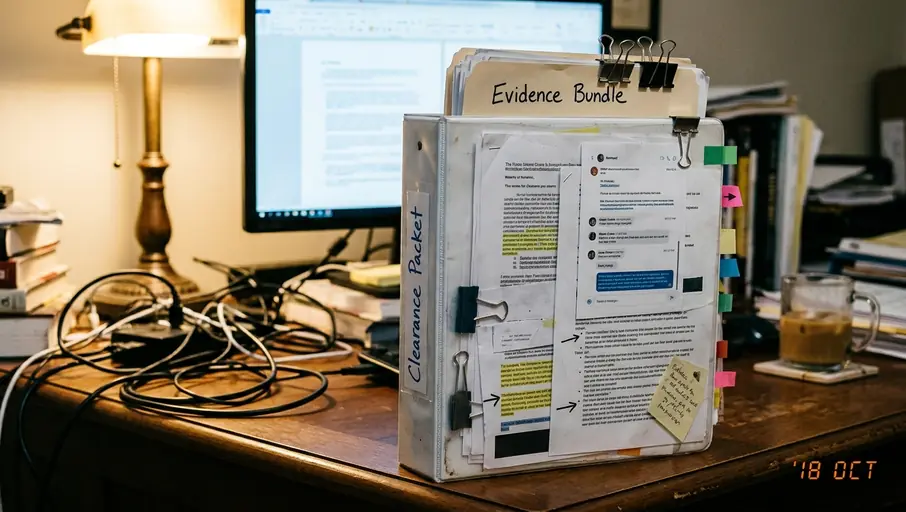
The clearance packet connects the proposed wording to its evidence with as little reconstruction as possible. It contains a context-wrapped quote ledger, an indexed evidence bundle, and a timestamped decision matrix.
The ledger includes each selected quote with its surrounding editorial paragraph. Alongside it sit the claim identifier, transcript location, proposed paraphrase where relevant, and artifact reference. Context matters: a technically accurate quotation can acquire a broader meaning through the sentence immediately before it.
The evidence bundle contains saved documentation excerpts, release notes, and other primary artifacts. Each attachment carries the identifier used in the ledger. Relevant passages are marked so counsel can inspect the evidence directly.
The decision matrix records the reviewer, status, requested change, resolution, and timestamp for each line item. Its purpose is to turn comments into explicit decisions.
Scheduling Verification and Resolution
The forty-eight-hour review target requires a complete packet, an agreed start time, and reviewers available within the scheduled window.
- Before the clock starts: The editor completes technical verification, resolves documentary contradictions, indexes the attachments, and identifies any necessary outside approvals.
- Day 1: Counsel reviews the ledger asynchronously, checks each statement against its attached proof, and marks individual entries as cleared or requiring a specific decision.
- Day 2: The editor resolves flagged wording in the same ledger. Counsel reviews those changes and returns the completed matrix.
A useful flag names the disputed words and proposes an action: narrow the environment, change the tense, remove the partner reference, or approve the attached formulation. That specificity allows the existing interview and documentation to answer the question.
The accompanying instruction defines factual and legal clearance as the review’s scope. Surrounding paragraphs provide meaning, while the claim identifiers keep comments attached to verifiable assertions. This structure reduces the invitation to recast the profile’s narrative voice during legal review.
Any external partner approval should be scheduled separately before committing to the internal review window.
Anchoring the Profile to the Audited Release
A startup can change its positioning while an executive profile moves through production. Version anchoring preserves the relationship between the published sentence and the product that supported it.
Each technical claim in the ledger therefore records the production release identifier active at the audit, the audit date, and the corresponding changelog attachment. Where a capability changes before publication, the article’s surrounding prose identifies the relevant release and uses a tense appropriate to that period.
A messaging change alone leaves the verified technical description intact. A published deprecation or security update that removes the capability triggers a targeted factual revision. The editor updates the affected claim, its context, and its clearance entry while preserving the rest of the record.
In the hypothetical workflow, the indexed packet reaches counsel on Tuesday morning. The editor confirms the attachments and starts the agreed review window that afternoon. Counsel opens the rendering claim, checks the version-locked wording against the attached release notes, and marks the entry cleared. On Thursday afternoon, the signed release returns; the selected quotes remain unchanged.











Responses
Be the first to comment.
Write a Comment